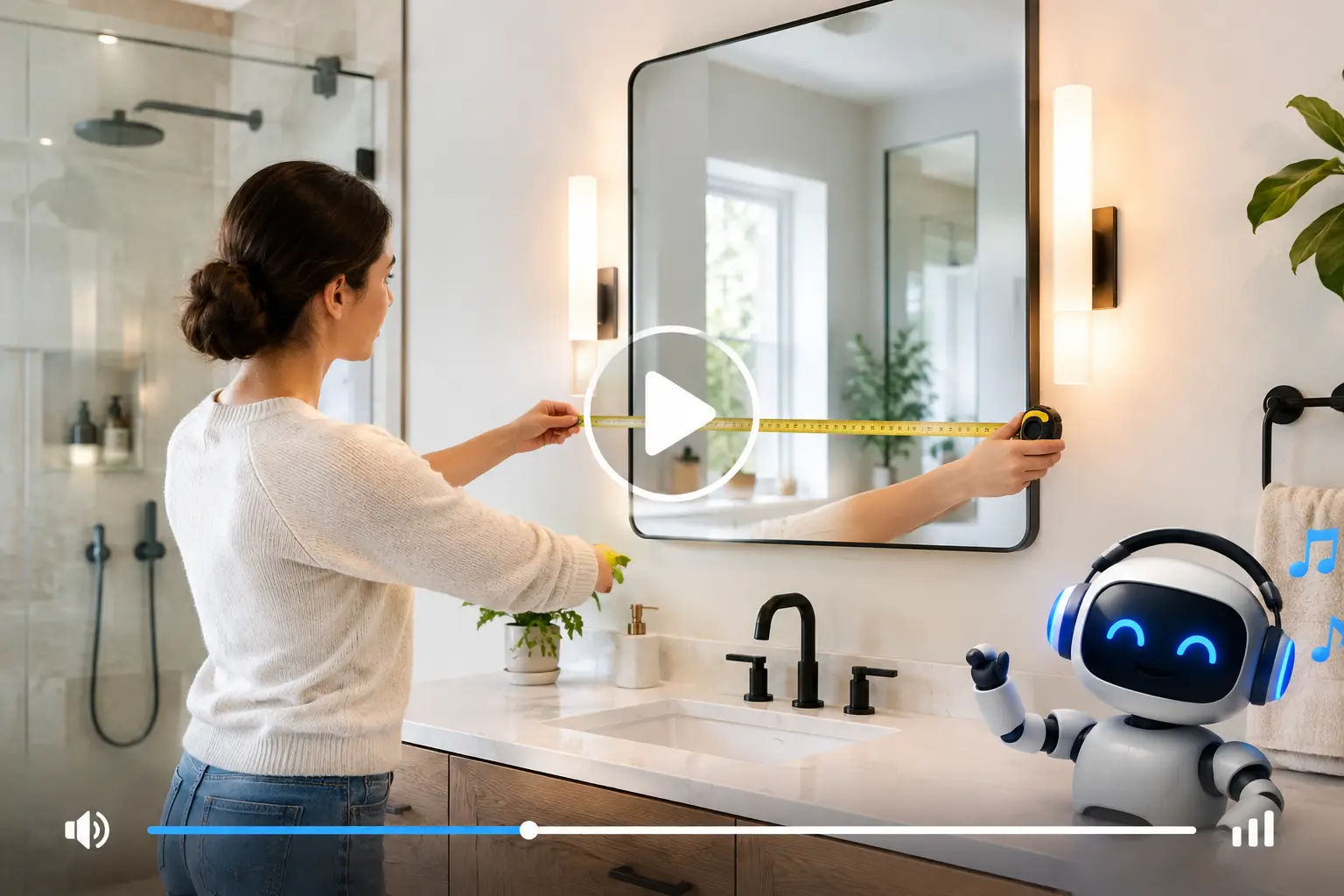
A mirror that is too small can make a well-designed vanity feel unfinished. One that is too wide, too low, or crowded by sconces can throw off the entire wall. Knowing how to choose bathroom mirror size starts with more than matching a mirror to a vanity. It means balancing proportion, daily function, lighting, and the architectural details already in the room.
For a bathroom renovation or new build, the mirror is often one of the final visible decisions. Yet its dimensions affect how spacious the room feels, how well the vanity wall works, and whether the finished space looks intentionally designed. A custom mirror gives you the freedom to fit the room properly rather than forcing the room to suit a standard size.
Start With the Vanity Width
The vanity is the most reliable reference point for choosing mirror width. In most bathrooms, the mirror should be no wider than the vanity. This keeps the composition grounded and prevents the mirror from visually extending beyond the cabinet below it.
For a single-vanity layout, a mirror that is about 70 to 80 percent of the vanity width often looks balanced. Another dependable approach is to leave roughly 2 to 4 inches of vanity visible on each side of the mirror. The better option depends on the look you want and the amount of open wall available.
A 36-inch vanity, for example, may suit a mirror between 24 and 30 inches wide. A 60-inch vanity may look best with a single 42- to 54-inch mirror, provided lighting and wall features allow it. A broader mirror can make a compact bathroom feel more open, while a narrower mirror can create a more tailored, furniture-like appearance.
The vanity should not be treated as an absolute rule. If a wall-to-wall backsplash, tall side cabinets, or a prominent window shapes the area, the mirror may need to respond to those elements first. The goal is for the full vanity wall to look considered, not for one measurement to dictate the entire design.
How to Choose Bathroom Mirror Size for Height
Width gets most of the attention, but mirror height has just as much impact on daily use. A mirror should comfortably reflect the faces of the people using it while maintaining a clear relationship with the faucet, countertop, lighting, and ceiling.
Most bathroom mirrors range from 30 to 40 inches tall, though taller installations are increasingly popular in modern bathrooms. A vertical mirror can add height in a room with lower ceilings. A wide horizontal mirror can emphasize a long floating vanity or create a calmer, more expansive feel.
As a starting point, leave enough space below the mirror so it does not feel pressed against the countertop or faucet. The ideal clearance varies with faucet height, backsplash material, and frame style, but the bottom edge should generally sit several inches above the highest part of the faucet. This gives the installation room to breathe and makes cleaning easier.
At the top, consider the room as a whole. A mirror that reaches too close to the ceiling may feel crowded in a standard bathroom, especially with a substantial frame. In a bathroom with tall ceilings, however, a larger custom mirror can make the wall feel complete rather than leaving an awkward band of empty space above the vanity.
Plan Around Lighting Before Finalizing Dimensions
Lighting changes the answer to almost every mirror-sizing question. If sconces are mounted beside the mirror, their size and placement limit how wide the glass can be. If lights sit above the mirror, the mirror height needs to leave enough room for the fixture without creating a cramped gap.
Side-mounted sconces provide flattering, even illumination for grooming, but they need a deliberate layout. Measure the fixture width, the distance from the mirror edge, and the clear space available to the left and right of the vanity. A mirror that looks ideal on paper may become too wide once light fixtures are included.
An overhead fixture gives more flexibility with mirror width. It may also allow a taller mirror, but make sure the light is installed at an appropriate height and does not cast strong shadows. For bathrooms with integrated backlit mirrors, confirm the electrical location and the visible glow around the mirror edge before committing to final dimensions.
A professional measurement appointment is useful here because small differences matter. Centering a mirror between two sconces, aligning it with a faucet, and accounting for fixture projections are details that create a finished result.
Single Mirror or Two Mirrors for a Double Vanity?
A double vanity offers two strong design directions: one large mirror or two separate mirrors. Neither is automatically better. The right choice depends on the vanity style, the wall width, the number of users, and the atmosphere you want to create.
One continuous mirror can make a bathroom feel larger and brighter. It works especially well above a long, streamlined vanity, in rooms where wall space is limited, or when a clean contemporary look is the priority. It also provides a generous reflective surface, which can be helpful in bathrooms with limited natural light.
Two mirrors establish individual zones at each sink. This approach can make a double vanity feel more organized and can introduce rhythm through matching round, arched, rectangular, or framed mirrors. It is a natural choice when there are separate sconces over each sink or when the vanity has two distinct cabinet sections.
When using two mirrors, avoid sizing each one as though it were alone on the wall. Consider the gap between them, the outer margins, and how they align with the sinks below. Equal spacing usually looks best, but a centered faucet and a centered mirror do not always land in the same place on custom cabinetry. Measure from the finished vanity layout, not from assumptions.
Consider Shape, Frame, and Visual Weight
A mirror’s outline affects how large it appears. A frameless rectangular mirror offers a clean, quiet look and maximizes the reflective area. It is a practical choice for tiled feature walls, compact bathrooms, and contemporary spaces where you want the finishes to do the talking.
A framed mirror has more visual weight, so it may need slightly more breathing room around it. The frame itself is part of the overall dimension. A slim black frame can add definition against a pale wall, while a warmer wood-tone or metallic frame can tie the mirror to cabinetry, hardware, or lighting.
Round and oval mirrors soften bathrooms dominated by straight lines. They work particularly well above narrower vanities, but their usable reflection area is smaller than a rectangular mirror of the same overall width and height. If multiple people use the bathroom or grooming function is a priority, choose a size that is generous enough to be practical, not just decorative.
Account for Backsplash, Tile, and Wall Conditions
The finished wall matters as much as the mirror itself. A full-height tile backsplash may call for a simple polished-edge mirror that preserves the tile pattern. A painted wall may benefit from a framed mirror that adds contrast and structure. If the mirror will cover a feature surface, decide whether you want to showcase that material or use it as a backdrop.
Installation conditions also deserve attention. Mirror weight, wall framing, electrical locations, and nearby plumbing all affect mounting options. Large custom mirrors should be measured, handled, and installed with the right materials and clearances, especially on tiled walls where an incorrect hole or poorly placed fastener can be costly to repair.
This is where working with a glass professional can protect both the design and the finish. Accurate site measurements confirm the true wall dimensions after tile, countertops, cabinetry, and lighting are in place. At AGS, custom mirror guidance is built around those final details so the glass fits the room you actually have, not the plan you started with.
Use These Proportions as Guidance, Not Limits
There is no single perfect formula for every bathroom. A powder room may benefit from an oversized statement mirror because it is used briefly and has fewer functional demands. A busy family bathroom may need a wider, taller mirror that serves several users comfortably. A small ensuite may look better with a mirror that stretches closer to the vanity edges to bring more light into the room.
Before placing an order, tape out the proposed mirror size on the wall. Stand back from the doorway, then look at it while standing at the vanity. Check how it relates to the faucets, sconces, cabinet edges, and ceiling line. This simple step often makes the right size immediately clearer.
The best bathroom mirror does more than fill a blank wall. It supports the way the room is used, reflects the design choices around it, and makes every morning routine feel a little more polished.
Leave a Reply