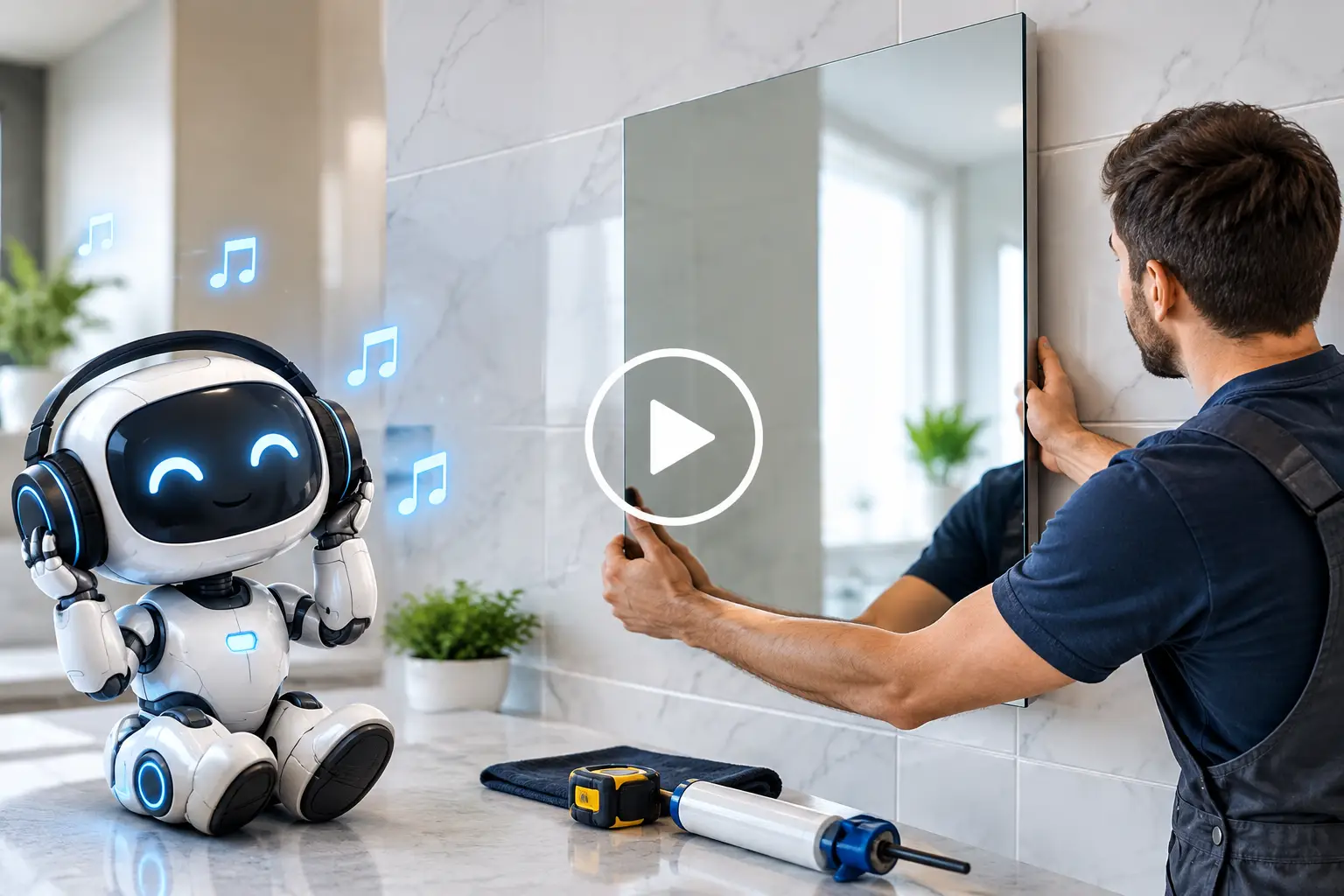
A new mirror can make a tiled bathroom feel brighter, larger, and more intentional – but it also raises a fair question: can mirrors be installed on tile without damaging the finished surface? Yes. The key is treating the tile, wall structure, mirror size, and mounting method as one installation system rather than simply attaching glass to a hard surface.
For a small, lightweight mirror, the approach may be straightforward. For a large vanity mirror, a full-height feature mirror, or a mirror above a floating vanity, precision becomes far more important. Tile can crack under the wrong drilling pressure, adhesive can fail on an unsuitable surface, and an inaccurate measurement can leave an awkward gap that is difficult to hide once the mirror is in place.
Can mirrors be installed on tile safely?
Mirrors can be installed on tile safely when the tile is sound, the wall behind it is suitable, and the mounting method is matched to the mirror’s weight and dimensions. In most cases, installers use a combination of purpose-made mirror adhesive and mechanical support, such as clips or concealed hardware, when the project calls for it.
The best method depends on the finished look you want. Some clients prefer visible polished clips for a clean, contemporary detail. Others want a mirror that appears to float directly on the tile, with no exposed hardware. Both can work well, but they require different planning before installation day.
A professional installation is not only about keeping the tile intact. It also accounts for safety, long-term adhesion, clean edges, electrical fixtures, plumbing locations, and the practical reality that mirrors are heavy, awkward to handle, and unforgiving once set in place.
What makes a tiled wall different?
Tile is durable on the surface, but it is not indestructible. Ceramic and porcelain tile can crack if drilled with the wrong bit, too much pressure, or too much heat. Natural stone adds another consideration: its appearance and porosity vary, so it may need different preparation and sealing awareness than manufactured tile.
Behind the tile, there may be drywall, cement board, waterproofing membrane, studs, or a combination of materials. That hidden construction matters. A tile anchor alone is not always enough to support a larger mirror. When possible, secure mechanical hardware into solid backing or framing rather than relying on the tile itself to carry the load.
Grout joints can sometimes offer a practical place for fasteners, but that is not an automatic rule. The location still has to work with the mirror layout, the wall structure, and the desired finished appearance. Drilling through grout may be less visually disruptive in some designs, yet it can limit exact placement if the mirror needs to align with lighting, a vanity, or other architectural details.
Choosing the right mounting method
There is no single answer for every tiled wall. The appropriate method comes down to mirror weight, tile type, wall condition, and whether future removal is likely to matter.
Mirror adhesive for a clean, hardware-free look
Neutral-cure, mirror-safe adhesive is commonly used to bond a mirror directly to tile. The product must be specifically compatible with mirror backing. Some general construction adhesives can damage the reflective backing over time, creating black spots or visible deterioration around the edges.
Adhesive is especially appealing for frameless vanity mirrors because it creates a crisp, uninterrupted surface. However, installation requires careful layout. Once a large mirror makes contact with adhesive, repositioning may not be possible without risking the tile or the mirror.
Adhesive also needs a clean, dry, stable surface. Dust, soap residue, uneven tile, loose grout, or moisture issues can compromise the bond. For heavier mirrors, adhesive may be paired with a temporary support rail during curing or with permanent lower support, depending on the design and site conditions.
Clips, channels, and mechanical support
Mirror clips, J-channels, and custom hardware provide physical support and can make future mirror replacement more manageable. A bottom channel can carry much of the mirror’s weight while discreet clips hold the top edge in position. This is often a sensible choice for larger mirrors or commercial spaces where durability and serviceability are priorities.
The trade-off is visibility. Even refined hardware becomes part of the design, although finishes such as chrome, matte black, brushed nickel, or brass can coordinate with faucets and lighting. In the right bathroom, clips look deliberate rather than distracting.
Framed mirrors and integrated backing
A framed mirror may use brackets, a hanging cleat, or other support hardware that changes how the load is distributed. This can be useful when the tile is decorative, textured, or not suitable for a full adhesive bond. It also gives homeowners more flexibility to introduce warmth through wood tones, metal finishes, or a bold frame profile.
Measurements matter more than most people expect
Tile walls tend to reveal small errors. A mirror that is a fraction of an inch off-center can look noticeably misaligned beside straight grout lines, a centered faucet, or a pair of sconces. Before fabrication, measure the installation area at more than one point. Walls, tile fields, and corners are not always perfectly square.
The mirror size should also leave appropriate clearance around outlets, light fixtures, faucets, backsplashes, and side walls. If sconces sit close to the mirror edge, the spacing needs to look balanced from both sides. If the mirror extends behind a faucet or near a backsplash, the installer must allow for the actual projection of those fixtures, not just the dimensions shown on a plan.
For a polished custom result, consider the mirror’s edges as part of the design. Polished edges suit many modern interiors, while beveled edges introduce a more traditional detail. A small gap around the perimeter may be intentional, especially where tile movement or uneven walls need to be accommodated. That gap can be left clean or finished thoughtfully depending on the room and mirror style.
Risks of a DIY tile mirror installation
Installing a small mirror on a simple tiled wall can be within reach for an experienced homeowner with the right tools. The risk rises quickly with size, weight, expensive tile, and complex bathroom layouts.
Common problems include drilling through tile too aggressively, cracking a corner tile, using adhesive that attacks mirror backing, missing wall studs, and setting the mirror slightly out of level. Another concern is cutting or drilling near electrical wiring, particularly around vanity lighting, switches, and outlets. Bathrooms can also have plumbing lines in unexpected places.
A large mirror presents a handling issue as well. Glass needs to be carried, supported, and set without twisting or striking tile edges. If it breaks, it can damage the completed room and create a serious safety hazard. Tempered or safety-backed mirror options may be appropriate in certain locations, but the right choice depends on the application and applicable building requirements.
When professional installation is the better choice
Professional fitting is particularly worthwhile when the mirror is oversized, custom cut, installed over premium tile, or intended to align with multiple design elements. It is also the more reliable route for mirrors near electrical fixtures, in busy commercial washrooms, or in homes where a clean, hardware-free finish is the goal.
An experienced glass team starts by reviewing the wall and taking accurate site measurements. From there, the mirror can be fabricated to suit the actual opening rather than an assumed dimension. The installation plan considers how the mirror will be supported, whether the tile can be drilled safely, and how to achieve consistent spacing around the finished piece.
For Edmonton-area renovation and new-build projects, Accel Glass Services helps homeowners and design professionals coordinate custom mirrors with the surrounding tile, fixtures, and overall room vision. That hands-on process helps prevent the small installation compromises that can take away from an otherwise beautifully finished space.
A few design choices worth deciding early
Before ordering a mirror, decide whether you want it to sit directly on the tile, extend close to the ceiling, stop above the backsplash, or align with the vanity width. Each choice changes the visual weight of the room.
A wide horizontal mirror can make a compact bathroom feel more open. Two separate mirrors can give a double vanity a more tailored appearance, especially when paired with individual sconces. In a powder room, a taller statement mirror may create more impact than a wider one. The tile pattern matters too: a mirror can either frame a beautiful feature tile or cover much of it, so it is worth viewing the layout as a whole before final measurements are taken.
The strongest installations look effortless because the details were resolved before the glass arrived. Choose a mounting method that respects the tile, specify a mirror built for the exact space, and give the finished room the careful fit it deserves.
Leave a Reply